
The soroban on your child’s desk is the result of more than five centuries of small improvements. Knowing where it comes from helps explain why it looks the way it does — one bead above the beam, four below — and why teachers still use it in the age of calculators.
This article follows the soroban from the counting boards of the ancient world to Chinese merchants, Edo-period classrooms, a famous contest against an electric calculator and today’s mental arithmetic lessons.
Before the soroban: counting boards and the Chinese suanpan
Many ancient cultures calculated by moving pebbles or counters on lines drawn on a board — the word “calculate” itself comes from the Latin calculus, a small stone. These counting boards worked on the same idea as the soroban: the position of a counter gives its value.
In China, the counters became beads threaded on rods inside a frame. This suanpan usually had 2 beads above the beam (each worth 5) and 5 below (each worth 1). By the Ming dynasty it was the everyday calculating tool of merchants and officials. In 2013, UNESCO inscribed Chinese zhusuan — knowledge and practices of calculating with the abacus — on its list of Intangible Cultural Heritage.
Arrival in Japan
The abacus and its methods came to Japan from China, most likely from the second half of the 15th century through trade. By around 1600 the word “soroban” already appeared in a Japanese–Portuguese dictionary, a sign that the tool was in common use.
Early Japanese arithmetic books then made it popular. Mōri Shigeyoshi’s Warizansho (1622) dealt with division on the abacus, and Yoshida Mitsuyoshi’s Jinkōki (first issued in 1627) taught the four operations with clear examples. Jinkōki became one of the best-selling books of the Edo period and spread soroban skills far beyond merchant families.
Reading, writing and soroban in Edo-period schools
During the Edo period (1603–1868), children of merchants and craftsmen studied at terakoya, small private schools. Their basic curriculum was summed up as “yomi, kaki, soroban” — reading, writing and the abacus. Calculating quickly and accurately was a practical skill for trade, rice taxes and bookkeeping.
This is also when the soroban became a Japanese craft. Regions such as Banshū (around Ono, in Hyōgo) and Unshū (Shimane) developed workshops that still make high-quality abacuses today.
From 2/5 to 1/4: why the beads changed
With 2 upper and 5 lower beads, a rod can show values up to 15. That was useful for some traditional Chinese methods, but it also means the same digit can be shown in more than one way. Japanese users gradually simplified the tool.
First the second upper bead was dropped, giving a 1/5 abacus. Later the fifth lower bead was removed. Accounts differ on the exact dates, but the modern 1/4 layout appeared around the end of the 19th century and became the standard during the 1930s and 1940s.
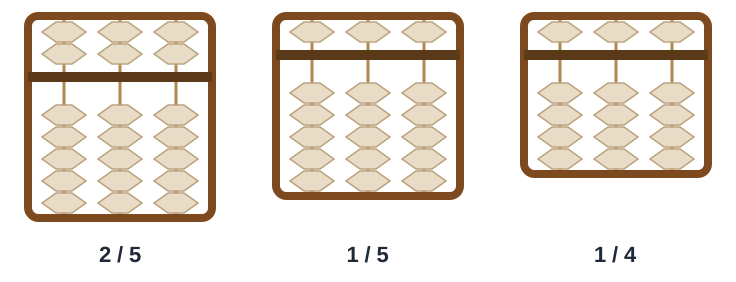
| Layout | Beads per rod | Maximum on one rod | What it means for learners |
|---|---|---|---|
| Chinese suanpan | 2 upper + 5 lower | 15 | Flexible, but some digits have two possible pictures |
| Early soroban | 1 upper + 5 lower | 10 | Simpler, still one spare lower bead |
| Modern soroban | 1 upper + 4 lower | 9 | One unique picture per digit; forces the friends of 5 and 10 |
The 1/4 layout is exactly why children learn the friends of 5 and 10: when a rod has no free bead, they must use the 5-bead or carry to the next rod. The tool itself teaches number decomposition.
1946: the soroban against the electric calculator
In November 1946, the US Army newspaper Stars and Stripes organised a public contest in Tokyo. Kiyoshi Matsuzaki, a clerk at the Japanese Ministry of Communications, used a soroban; Private Thomas Nathan Wood used one of the best electric calculators of the time.
The soroban won four of the five events — addition, subtraction, division and a mixed problem — and lost only multiplication. The story is often told to show that a trained human with a simple tool can be remarkably fast, not that machines are useless.
The soroban today: from calculator to learning tool
Electronic calculators replaced the soroban in offices from the 1970s. Its role in education, however, stayed. Japanese primary-school mathematics still introduces the soroban, many children attend juku (after-school classes) and national exams award grades from beginner levels up to dan ranks.
Researchers became interested in a striking effect: trained users can calculate with an imagined abacus. Studies of Chinese and American children showed that this “mental abacus” works differently from verbal counting (Stigler, 1984), and later work confirmed that users store numbers as visual bead images (Frank & Barner, 2012). This is the anzan described in our introduction to the soroban.
Around the world, families now combine a physical abacus with online tools. If you are choosing between them, read our comparison of physical and digital soroban, or try the online soroban right away.
Timeline at a glance
Key moments in the history of the soroban, simplified:
| Period | Event |
|---|---|
| Antiquity | Counting boards with pebbles or counters in many cultures |
| Ming dynasty China | The bead suanpan (2/5) becomes the everyday calculating tool |
| 15th–16th century | The abacus reaches Japan through trade with China |
| 1622 and 1627 | Warizansho and Jinkōki popularise soroban methods |
| Edo period | Terakoya schools teach “reading, writing and soroban” |
| Late 19th – mid 20th century | The layout simplifies to 1/5, then the modern 1/4 |
| 1946 | The soroban beats an electric calculator in a Tokyo contest |
| 2013 | UNESCO inscribes Chinese zhusuan as Intangible Cultural Heritage |
Conclusion
The soroban is not an old toy but a carefully refined tool. Each change — fewer beads, clearer rods, unit dots — made it easier to see place value and harder to make ambiguous moves. That design is exactly what makes it such a good teacher of number sense for children today.
Ready to try it? Start with the learning path, or read when and how to introduce anzan to see where the journey leads.
Frequently asked questions
Where does the soroban come from?
The soroban comes from the Chinese suanpan, which reached Japan around the 15th–16th century. Japanese users then simplified its bead layout.
Why does the soroban have 4 lower beads instead of 5?
With 1 upper and 4 lower beads, each digit from 0 to 9 has exactly one picture on a rod. This removes ambiguity and makes calculation rules clearer.
What is the difference between a soroban and a suanpan?
A suanpan usually has 2 upper and 5 lower beads per rod; a modern soroban has 1 upper and 4 lower. The soroban also has smaller, diamond-shaped beads designed for fast finger movements.
Did the soroban really beat an electric calculator?
Yes. In a 1946 contest in Tokyo, a soroban expert won four of five events against an electric calculator, losing only in multiplication.
Is the soroban still used in Japan?
Yes, mostly as a learning tool. Children meet it in primary school, and many attend soroban classes and take graded exams.
Sources
- UNESCO (2013). Chinese Zhusuan, knowledge and practices of mathematical calculation through the abacus. Representative List of the Intangible Cultural Heritage of Humanity.
- National Diet Library of Japan. Japanese Mathematics in the Edo Period — Chapter 1: Early Edo Period.
- Stigler, J. W. (1984). “Mental abacus”: The effect of abacus training on Chinese children’s mental calculation. Cognitive Psychology, 16(2).
- Frank, M. C., & Barner, D. (2012). Representing exact number visually using mental abacus. Journal of Experimental Psychology: General, 141(1).