
Once children add and subtract confidently on the soroban, multiplication is the natural next step — and often the moment they realise how powerful the abacus is. A problem like 46 × 3 becomes a few clear bead movements instead of a page of written work.
This guide explains the idea behind soroban multiplication, what your child needs to know first, a step-by-step method with worked examples, a four-level practice plan with answers, and the most common mistakes.
The big idea: multiply digit by digit, then add
The soroban never multiplies large numbers in one go. It splits them into products of single digits — the times tables — and adds each product on the right rods. Because the soroban is excellent at addition, multiplication becomes a series of additions placed by value.
Take 23 × 4. The 2 in 23 means 2 tens, so 4 × 2 tens = 8 tens = 80. Then 4 × 3 = 12. Add them: 80 + 12 = 92. On the soroban, you set 80, then add 12 one rod to the right of where you set the 8 — exactly the movements shown below.
Experienced users later run the same bead movements on an imagined abacus (Stigler, 1984). In a large school study in India, children taught the mental abacus over several years did better in arithmetic than a comparison group, although the benefit varied from child to child (Barner et al., 2016).
What your child needs before starting
Multiplication combines several skills. Check these first:
- Sets and reads any number up to 999 without counting beads.
- Adds two-digit numbers accurately, including the friends of 5 and 10.
- Knows most of the times tables from 2 to 9 without counting on fingers.
- Understands place value: the 2 in 23 is worth 20, not 2.
If the times tables are still shaky, practise them separately for a few minutes a day, for example with flash cards, while continuing addition on the soroban. Mixing a new method with uncertain facts makes both harder.
The two-rod rule
Every product of two single digits is written as two digits: a tens digit and a ones digit. 3 × 4 = 12, and 2 × 4 = 08. Thinking “zero-eight” instead of “eight” keeps every product exactly two rods wide.
Where does the pair go? Its ones digit lands on the place value of the two digits multiplied: ones × ones lands on the ones rod, tens × ones on the tens rod, tens × tens on the hundreds rod. The tens digit of the pair sits one rod to the left. Your child does not need to memorise this sentence; saying the place values aloud during the first weeks is enough.
Step by step: 23 × 4
Choose a unit dot as the ones rod and clear the soroban. Then follow these steps, saying each one aloud:
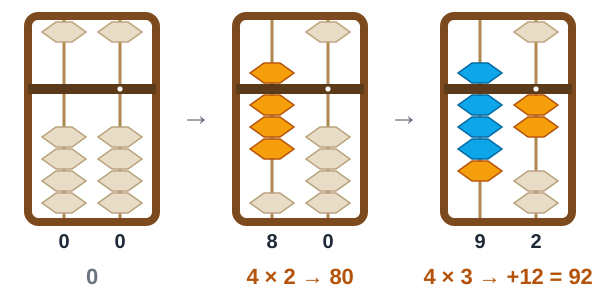
- Multiply the tens digit: 4 × 2 = 08. It means 8 tens, so set 8 on the tens rod. The soroban shows 80.
- Multiply the ones digit: 4 × 3 = 12. Add 1 on the tens rod and 2 on the ones rod.
- Read the answer: 92. Check with a quick estimate: 23 is close to 25, and 25 × 4 = 100, so 92 is reasonable.
With a carry: 46 × 3. First 3 × 4 = 12 tens, so set 120. Then 3 × 6 = 18: add it to get 138. The carry is handled automatically by soroban addition — another reason the friends of 10 must be secure first.
Two-digit by two-digit: 23 × 14
With two-digit multipliers, add four partial products. For 23 × 14:
- 2 tens × 1 ten = 2 hundreds → set 200.
- 2 tens × 4 = 8 tens → add 80 (total 280).
- 3 × 1 ten = 3 tens → add 30 (total 310).
- 3 × 4 = 12 → add 12 (total 322).
Children can also split the problem into two steps they already know: 23 × 10 = 230 and 23 × 4 = 92, then 230 + 92 = 322. Both routes give the same answer; the first is closer to how soroban schools work, the second is a good bridge for beginners.
A note on layouts: soroban schools in Japan use a standard arrangement in which the multiplicand is set on the abacus and the products are placed according to fixed rules. Your teacher may place numbers differently from this article, but the principle — single-digit products added by place value — is the same.
A four-level practice plan with answers
Stay at a level until your child solves most problems correctly without hurrying, then move on.
| Level | Type | Examples (answers) |
|---|---|---|
| 1 | 2 digits × 1 digit, no carrying | 21 × 3 (63), 32 × 3 (96), 12 × 4 (48) |
| 2 | 2 digits × 1 digit, with carrying | 46 × 3 (138), 27 × 4 (108), 58 × 6 (348) |
| 3 | 3 digits × 1 digit | 123 × 3 (369), 214 × 4 (856), 365 × 7 (2555) |
| 4 | 2 digits × 2 digits | 23 × 14 (322), 31 × 22 (682), 45 × 12 (540) |
Five to eight problems a day is plenty. Short, regular practice spread over several days builds stronger memory than one long session (Cepeda et al., 2006). Our 10-minute daily routine shows how to fit multiplication into a session, and you can print extra sheets from the worksheets page.
Common mistakes and quick fixes
Most errors fall into four groups:
- Product on the wrong rod (answer 10 times too big or too small): mark the ones rod with a finger and say the place value — “tens times ones gives tens”.
- Forgetting a zero product: in 205 × 3, 3 × 0 = 00 still takes its place, so the answer is 615, not 75 or 6015.
- Slow times tables: if your child pauses to count, practise the facts separately; the soroban method cannot be faster than the facts it uses.
- Carry errors: they are addition errors. Go back to a few days of addition with the friends of 10.
Encourage a quick estimate before each problem. If 365 × 7 is “about 400 × 7 = 2800”, an answer of 25 550 is obviously wrong. Estimating also builds the number sense that makes anzan possible later.
Conclusion
Soroban multiplication is not a new trick to memorise: it is the times tables plus soroban addition, organised by place value. Make sure addition and the facts are solid, use the two-rod rule, move through the four levels slowly, and estimate every answer. Children who learn it this way often find written multiplication easier too, because they can see why each digit goes where it does.
To keep foundations strong, alternate multiplication days with our easy soroban exercises and practise on the online soroban.
Frequently asked questions
How do you multiply on a soroban?
You split the problem into single-digit products from the times tables and add each product on the rods that match its place value. For 23 × 4: 4 × 2 tens = 80, plus 4 × 3 = 12, gives 92.
When should a child start soroban multiplication?
When addition with the friends of 5 and 10 is automatic and the times tables are mostly known. For many children this is after several months of regular practice.
Does my child need to know the times tables first?
Yes, mostly. The soroban adds the products quickly, but it does not replace knowing that 7 × 8 = 56.
Why write 2 × 4 as 08?
Writing every product with two digits keeps it exactly two rods wide, so each product lands in the right place and no digit shifts.
Is soroban multiplication faster than written multiplication?
With practice, usually yes, because there is nothing to write down and carries are handled by bead movements. Accuracy matters more than speed at the start.
Sources
- Stigler, J. W. (1984). “Mental abacus”: The effect of abacus training on Chinese children’s mental calculation. Cognitive Psychology, 16(2).
- Barner, D., et al. (2016). Learning mathematics in a visuospatial format: A randomized, controlled trial of mental abacus instruction. Child Development, 87(4).
- Cepeda, N. J., et al. (2006). Distributed practice in verbal recall tasks: A review and quantitative synthesis. Psychological Bulletin, 132(3).