
Parents often hear about the abacus method through a course, a video or another family. The name can sound like a single trademarked system, but it simply describes a way of learning: first move real beads, then picture them to calculate mentally.
This guide explains what the method involves, how it relates to the soroban, the four usual stages and a worked example. It also separates what research supports from what advertising sometimes promises.
What is the abacus method?
The word abacus comes from Latin and originally referred to a calculating board. Today it describes a frame with beads on rods. In the abacus method, each rod stands for a place value, so a child can see a number and physically carry out each step of a calculation.
With practice, many learners stop needing the frame. They picture the beads and move them in their minds. Researchers call this “mental abacus”, and a study of trained users found that they represent numbers as visual images rather than as words (Frank & Barner, 2012).
Abacus method or soroban method: what is the difference?
“Abacus” is the general word. The soroban is one specific abacus: the Japanese version, with one upper bead and four lower beads on each rod. The Chinese suanpan traditionally has two upper and five lower beads. Our history of the soroban explains how the layout changed.
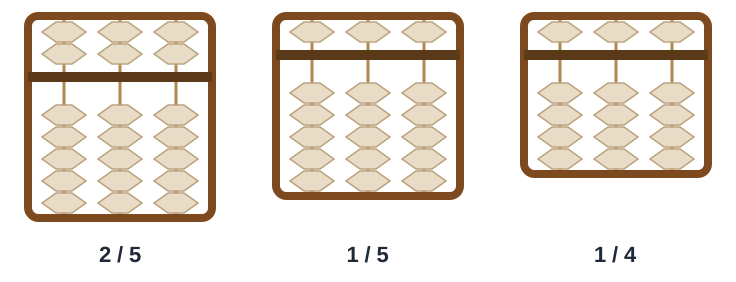
| Term | What it means | Beads per rod |
|---|---|---|
| Abacus | The whole family of bead-based calculating tools | Depends on the model |
| Suanpan | Traditional Chinese abacus | 2 upper + 5 lower |
| Soroban | Modern Japanese abacus | 1 upper + 4 lower |
Commercial programmes such as UCMAS have their own materials and levels. Before you sign up, ask which abacus is used, how long each level lasts and how progress is checked.
The four stages of the abacus method
Programmes use different names, but they usually follow this progression:
- Read and show numbers. The child learns bead values and place value on the online soroban or a physical abacus.
- Add and subtract on the abacus. When a rod has no free bead, the child uses the friends of 5 and 10.
- Build the mental image. The child looks at a number, closes their eyes and describes the beads, starting with very small numbers.
- Calculate mentally. Short problems move from the abacus to the imagination, as explained in our guide on introducing anzan.
A worked example: 37 + 25
Start with 37 on the abacus and work from left to right:
- Add the 2 tens. The tens rod shows 3 and has only one free lower bead, so add the 5-bead and remove 3 lower beads. The tens rod now shows 5.
- Add the 5 units. The units rod shows 7 and its 5-bead is already in use, so add 1 to the tens rod and remove the 5-bead from the units rod.
- Read the result: 6 tens and 2 units, so 62.
Once this feels easy, the child repeats the same movements with no abacus, in their imagination. Speed comes after accuracy, never before it.
What does research show?
In a three-year randomised trial with about 200 children in India, mental-abacus instruction led to better arithmetic results than standard extra maths lessons. It did not change basic cognitive abilities (Barner et al., 2016).
A 1984 study had already described fast mental calculation in abacus-trained Chinese children, with errors that pointed to a mental image of the abacus (Stigler, 1984). A 2020 review adds that training may support working memory and number processing, but calls for caution before generalising (Wang, 2020). Read more in our article on the benefits of soroban for children.
Some courses also teach finger movements that imitate the beads. The studies cited here examine abacus and mental-abacus training, so they should not be read as proof that one finger technique is better than another.
How to try the method at home
You can test the method for a few weeks before paying for a course:
- Practise for about 10 minutes a day rather than for one long weekly session.
- Follow the free learning path to keep the steps in order.
- Use the interactive exercises and printable worksheets to check accuracy.
- Add short mental exercises only when the child can do the same problems comfortably on the abacus.
For a detailed schedule, see our four-week plan for learning at home.
Conclusion
The abacus method is a progression rather than a secret: understand numbers on beads, automate the movements, then imagine them. Its best-supported benefit is stronger arithmetic. Start small, keep practice regular and judge any course by its teaching, not its promises.
Frequently asked questions
Is the abacus method the same as soroban?
Not exactly. Abacus is the general word and the soroban is a specific Japanese abacus. Many abacus courses do use a soroban or a similar 1/4 layout, so the learning path is often very close.
At what age can a child start?
It depends more on readiness than on a birthday. A child should be able to recognise numbers and stay focused for a few minutes. See our guide to the best age to start.
Can the abacus method be learned online?
Yes. A virtual abacus works well for the basics, and many families combine it with a physical one. Regular practice and feedback matter more than the format.
How long does it take to calculate mentally?
There is no fixed timetable. It depends on the child’s age, the regularity of practice and the difficulty of the calculations. Small additions can come first; long calculations take much longer.
Does the abacus method increase IQ?
No reliable study shows that. A large randomised trial found better arithmetic but no change in basic cognitive abilities (Barner et al., 2016).
Sources
- Barner, D., et al. (2016). Learning mathematics in a visuospatial format: A randomized, controlled trial of mental abacus instruction. Child Development, 87(4).
- Frank, M. C., & Barner, D. (2012). Representing exact number visually using mental abacus. Journal of Experimental Psychology: General, 141(1).
- Stigler, J. W. (1984). “Mental abacus”: The effect of abacus training on Chinese children’s mental calculation. Cognitive Psychology, 16(2).
- Wang, C. (2020). A review of the effects of abacus training on cognitive functions and neural systems in humans. Frontiers in Neuroscience, 14.